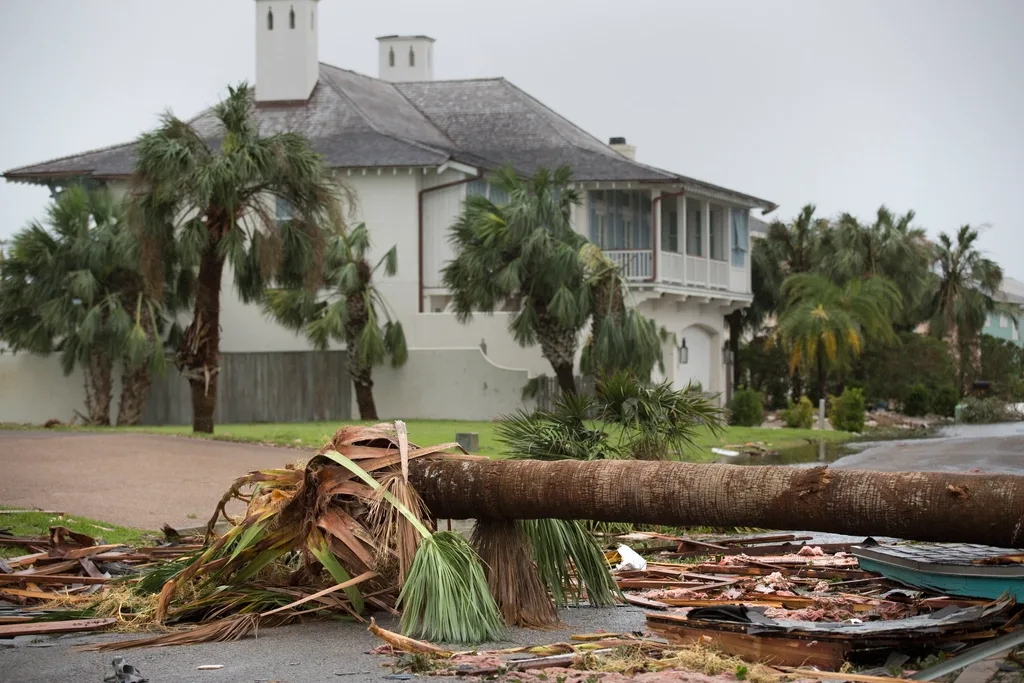
Hollywood sits on the Atlantic coast in southern Broward County, between the ocean, the Intracoastal Waterway, and neighborhoods that run west past U.S. 1 and Interstate 95. That geography shapes hurricane claims here. Homes near the water face storm surge as well as wind, and every home in the county falls within the Florida Building Code’s High-Velocity Hurricane Zone. This guide covers what is specific to Hollywood and Broward, and points to our statewide resources for the rest.
- The Florida Building Code places all of Broward and Miami-Dade counties in the High-Velocity Hurricane Zone, which affects how damaged homes must be repaired (Florida Building Code, ch. 2).
- Florida’s hurricane deductible applies once per calendar year to covered hurricane losses under policies from the same insurer or insurer group (Fla. Stat. § 627.701(5)(a)).
- Homeowners policies generally exclude flood, including storm surge (Fla. Stat. § 627.7011(4)(b)). Flood damage is a separate claim, usually under a National Flood Insurance Program (NFIP) policy (FEMA FloodSmart).
- For hurricane claims, the date of loss is the date the hurricane made landfall (Fla. Stat. § 627.70132(3)). Notice is due within 1 year for an initial claim and 18 months for a supplemental claim (Fla. Stat. § 627.70132).
- Broward County’s hurricane hotline is 311, or (954) 831-4000 (Broward County).
Which hurricanes have damaged homes in Hollywood and Broward County?
National Hurricane Center (NHC) reports on recent storms show the kinds of damage Broward homeowners tend to claim:
- Hurricane Katrina (2005). Before its Gulf Coast landfall, Katrina made its first United States landfall as a Category 1 hurricane near the border of Miami-Dade and Broward counties on August 25, 2005 (NHC Hurricane Katrina report). The NHC’s report notes that downed trees in Broward County caused three of the storm’s direct deaths in Florida (NHC Hurricane Katrina report).
- Hurricane Wilma (2005). Wilma made landfall near Cape Romano in southwest Florida on October 24, 2005, and crossed the peninsula in about 4.5 hours (NHC Hurricane Wilma report). The NHC concluded that parts of Broward County likely had Category 2 hurricane conditions (NHC Hurricane Wilma report). It described downed trees and power lines, broken windows, extensive roof damage, and destroyed mobile homes across southern Florida (NHC Hurricane Wilma report).
- Hurricane Irma (2017). Irma made landfall in the Florida Keys and again near Marco Island on September 10, 2017 (NHC Hurricane Irma report). The NHC reported widespread tree and power pole damage in the Miami and Fort Lauderdale metro area, and maximum inundation of 2 to 4 feet above ground level along coastal sections of northern Miami-Dade, Broward, and Palm Beach counties (NHC Hurricane Irma report).
As Wilma and Irma show, a storm does not have to make landfall in Broward to damage homes here. Roof damage, broken windows, fallen trees, and water intrusion appear again and again in these reports, and properties near the coast can face both wind and surge from the same storm.
How does the High-Velocity Hurricane Zone affect repairs and claims?
The Florida Building Code defines the High-Velocity Hurricane Zone (HVHZ) as Broward and Miami-Dade counties (Florida Building Code, ch. 2). The code includes structural design sections that apply specifically in the HVHZ (Florida Building Code, ch. 16). For a homeowner with a claim, that matters in three ways.
Repairs usually need a permit. Under section 105.1 of the Florida Building Code, an owner who intends to repair or replace a building, or to install or replace impact-resistant coverings such as shutters, must first apply to the building official and obtain the required permit, unless the work is exempt (Florida Building Code, sec. 105.1). A repair that is quick to patch may still have to be done to code.
Code upgrades cost money, and coverage for them has limits. Meeting current code can add cost beyond simply replacing what was there. Law and ordinance coverage pays for those added costs up to its limit. Under Fla. Stat. § 627.7011, a homeowners policy is deemed to include law and ordinance coverage of 25 percent of the dwelling limit unless the policyholder rejected it in writing, and insurers must offer a 50 percent option. Fla. Stat. § 626.9744(1) adds that, unless the policy specifically excludes or limits it, the insured may not be required to pay for betterment required by ordinance or code, except for the deductible.
Estimates should reflect local requirements. When you compare the insurer’s estimate with your contractor’s, check that the scope includes the materials and methods the code and the permit require for your home.
How does your hurricane deductible work?
Your policy may carry a separate hurricane deductible, often a percentage of the dwelling limit rather than a flat dollar amount (Fla. Stat. § 627.701(3)). Before issuing a personal residential policy, Florida insurers generally must offer hurricane deductibles of $500, 2 percent, 5 percent, and 10 percent of the dwelling limit, with some exceptions based on the dwelling limit (Fla. Stat. § 627.701(3)).
Two rules are worth knowing:
- It applies once per calendar year. For personal residential policies, the hurricane deductible applies on an annual basis to all covered hurricane losses in a calendar year under policies from the same insurer or insurer group (Fla. Stat. § 627.701(5)(a)). After a first hurricane, the insurer may apply the greater of the remaining hurricane deductible or the other-perils deductible to a later hurricane that year (Fla. Stat. § 627.701(5)(a)). Keep records of losses below the deductible.
- It depends on how Florida defines a hurricane. Under Fla. Stat. § 627.4025(2)(c), a hurricane is a storm system the NHC has declared a hurricane. The hurricane period begins when a hurricane warning is issued for any part of Florida and ends 72 hours after the last hurricane watch or warning for any part of Florida ends (Fla. Stat. § 627.4025(2)(c)). Damage from a tropical storm that never met that definition may fall under a different deductible, so check which one the insurer applied.
The deductible is subtracted from the covered loss, so it can change the math of a claim. Look at your declarations page now, before a storm.
Wind or water: who pays for storm damage near the coast?
This is the dispute that comes up most often in coastal claims. A homeowners policy that covers windstorm generally covers wind damage during a hurricane. Under Fla. Stat. § 627.4025(2)(a), hurricane coverage includes ensuing damage to the interior of a building, or property inside it, caused by rain if the direct force of the windstorm first damages the building and creates an opening through which the rain enters.
Flood is a different matter. Florida law requires a homeowners policy that does not include flood coverage to state on the declarations page, in bold type, that it does not cover damage from flood even if hurricane winds and rain caused the flood (Fla. Stat. § 627.7011(4)(b)). Homeowners policies generally treat storm surge as flood. Flood coverage usually comes from a separate NFIP policy or a private flood policy, and that claim is reported to the flood insurer separately.
Two practical points for Hollywood homeowners:
- Buy flood coverage before the season, not before the storm. FEMA says there is typically a 30-day waiting period from the date of purchase before an NFIP policy goes into effect (FEMA). You can look up your flood zone on FEMA’s Flood Map Service Center.
- Know your evacuation zone. Broward County uses two plans based on storm surge (Broward County). Plan A, typically for a Category 1 or 2 hurricane, covers areas east of the Intracoastal Waterway, mobile homes, and low-lying areas (Broward County). Plan B, typically for Category 3 or higher, adds areas east of U.S. 1 (Federal Highway; Broward County). The county’s evacuation page has the map.
When a home has both wind and water damage, the two insurers may each point to the other. Photos taken as soon as it is safe, showing roof openings, broken windows, and water lines, help separate the causes. The Florida Department of Financial Services (DFS) publishes consumer guides to homeowners and flood claims in its storm resources.
What should you do in the first days after a storm in Hollywood?
Safety comes first. Stay away from downed power lines and standing water, and do not enter a building that may be unsafe. For county services before, during, and after a hurricane, Broward County Emergency Management’s hotline is 311 or (954) 831-4000 (Broward County). The City of Hollywood’s hurricane preparedness page asks residents to plan to be self-sufficient for at least five to seven days after a hurricane (City of Hollywood).
Once it is safe:
- Photograph and video all damage, inside and out, before cleanup.
- Make reasonable temporary repairs, such as tarping a roof, to prevent further damage, and keep every receipt.
- Keep damaged materials if you can, or at least photograph them before they go to the curb.
- Report the claim to your insurer, and to your flood insurer if there is water damage from flooding.
- Confirm a contractor’s license through the Florida Department of Business and Professional Regulation before you sign, as the Homeowner Claims Bill of Rights advises (Fla. Stat. § 627.7142).
Our hurricane damage claim checklist for Florida covers documentation, communications, and paperwork in detail.
What are the Florida deadlines for a hurricane claim?
Deadlines are set by state law and apply the same way in Hollywood as anywhere else in Florida:
- Date of loss. For hurricanes, the date of loss is the date the hurricane made landfall (Fla. Stat. § 627.70132(3)).
- Claim notice. An initial or reopened claim must be noticed within 1 year after the date of loss, and a supplemental claim within 18 months (Fla. Stat. § 627.70132(2)).
- Insurer response. The insurer must acknowledge your claim communication within 7 calendar days, complete any physical inspection within 30 days after receiving proof-of-loss statements, and generally pay or deny the claim within 60 days after receiving notice (Fla. Stat. § 627.70131).
- Before a lawsuit. A written notice of intent to initiate litigation must be filed with DFS at least 10 business days before suit (Fla. Stat. § 627.70152).
- Lawsuit. An action for breach of a property insurance contract must be filed within five years from the date of loss (Fla. Stat. § 95.11(2)(e)).
Your policy may also require prompt notice, a sworn proof of loss, or other steps. Report as soon as you reasonably can.
Questions about your hurricane claim?
The consultation is free. Tell us what was damaged, when you reported it, and what your insurer has said so far.
What if your insurer underpays or denies a hurricane claim?
A low payment and a denial call for different responses. If the insurer accepted the claim but paid less than the repairs will cost, start with its detailed estimate. Florida law requires the insurer to send you a copy within 7 days after its adjuster generates it, and to explain in writing if it pays less than that estimate (Fla. Stat. § 627.70131). Our guide to an underpaid property insurance claim in Florida covers depreciation holdbacks, supplemental claims, and appraisal.
Other paths include:
- DFS mediation. A free, nonbinding conference with a neutral mediator for most residential disputes of $500 or more after the deductible (Fla. Stat. § 627.7015).
- Appraisal. A contract process in most policies for disputes over the amount of the loss (Fla. Stat. § 627.7015(1)).
- Legal action. After the required presuit notice, a lawsuit for breach of the policy.
Consider speaking with an attorney if the claim is denied or partly denied, the offer is far below your contractor’s estimate, the insurer requests an examination under oath, you receive a reservation of rights letter, or a deadline is approaching. Our Florida hurricane damage claims page explains how we approach these cases.
Frequently asked questions
Is Hollywood, FL in the High-Velocity Hurricane Zone?
Yes. The Florida Building Code defines the High-Velocity Hurricane Zone as Broward and Miami-Dade counties, and Hollywood is in Broward County. Repairs to a damaged home generally need a permit and must meet the code’s requirements for the zone.
Does my homeowners policy cover storm surge in Broward County?
Usually not. Homeowners policies generally exclude flood, including storm surge, and Florida requires policies without flood coverage to say so on the declarations page. Flood damage is usually claimed under a separate NFIP or private flood policy.
How many times can my hurricane deductible apply in one year?
For personal residential policies, the hurricane deductible applies once per calendar year to covered hurricane losses under policies from the same insurer or group. For a later hurricane that year, the insurer may apply the greater of the remaining hurricane deductible or the other-perils deductible.
What is the date of loss for a hurricane claim in Florida?
Under Fla. Stat. § 627.70132(3), the date of loss for a hurricane claim is the date the hurricane made landfall. Your 1-year deadline for an initial claim and 18-month deadline for a supplemental claim run from that date.
Is there a waiting period for flood insurance?
FEMA says there is typically a 30-day waiting period from the date of purchase before an NFIP flood policy goes into effect, with some exceptions. Buying coverage when a storm is already approaching may be too late for that storm.
Who do I call in Broward County after a hurricane?
For county services, call Broward County Emergency Management’s hurricane hotline at 311 or (954) 831-4000. For your claim, report it to your insurer and flood insurer. For legal questions about a disputed claim, you can schedule a free consultation with MAC Legal P.A.
How MAC Legal can help
MAC Legal P.A. is a plaintiff-side trial firm with its primary office at 4601 Sheridan Street in Hollywood, Florida. Michael A. Citron is licensed by The Florida Bar and represents homeowners, condominium and HOA boards, and businesses throughout Florida in disputes with their property insurers, including denied, delayed, and underpaid hurricane claims. We also work with licensed public adjusters when a claim needs legal help.
If a hurricane damaged your Hollywood or Broward property and your claim is not going the way it should, schedule a free consultation. We will review your policy and the insurer’s position and explain your options plainly.
This article provides general information about Florida law as of November 27, 2026, and is not legal advice. Reading it does not create an attorney-client relationship. Storm details come from National Hurricane Center reports, and local information comes from Broward County and the City of Hollywood, and may change.
Sources
- National Hurricane Center, Tropical Cyclone Report: Hurricane Katrina (PDF)
- National Hurricane Center, Tropical Cyclone Report: Hurricane Wilma (PDF)
- National Hurricane Center, Tropical Cyclone Report: Hurricane Irma (PDF)
- Florida Building Code, Building, Chapter 2 Definitions: High-Velocity Hurricane Zone
- Florida Building Code, Building, Section 105.1: Permits required
- Fla. Stat. § 627.701, Florida Senate: Liability of insureds; coinsurance; deductibles
- Fla. Stat. § 627.4025, Florida Senate: Residential coverage and hurricane coverage defined
- Fla. Stat. § 627.7011, Florida Senate: Replacement cost coverage and law and ordinance coverage
- Fla. Stat. § 626.9744, Florida Senate: Claim settlement practices relating to property insurance
- Fla. Stat. § 627.70132, Florida Senate: Notice of property insurance claim
- Fla. Stat. § 627.70131, Florida Senate: Insurer’s duty to acknowledge communications regarding claims; investigation
- Fla. Stat. § 627.70152, Florida Senate: Suits arising under a property insurance policy
- Fla. Stat. § 627.7015, Florida Senate: Alternative procedure for resolution of disputed property insurance claims
- Fla. Stat. § 95.11, Florida Senate: Limitations other than for the recovery of real property
- FEMA, Waiting Period for Activating Flood Policy
- Broward County, Official Hurricane Site: Evacuations
- City of Hollywood, Hurricane Season Preparedness
- Florida Department of Financial Services, storm consumer resources